The biggest and smallest countries by area, and why rankings shift
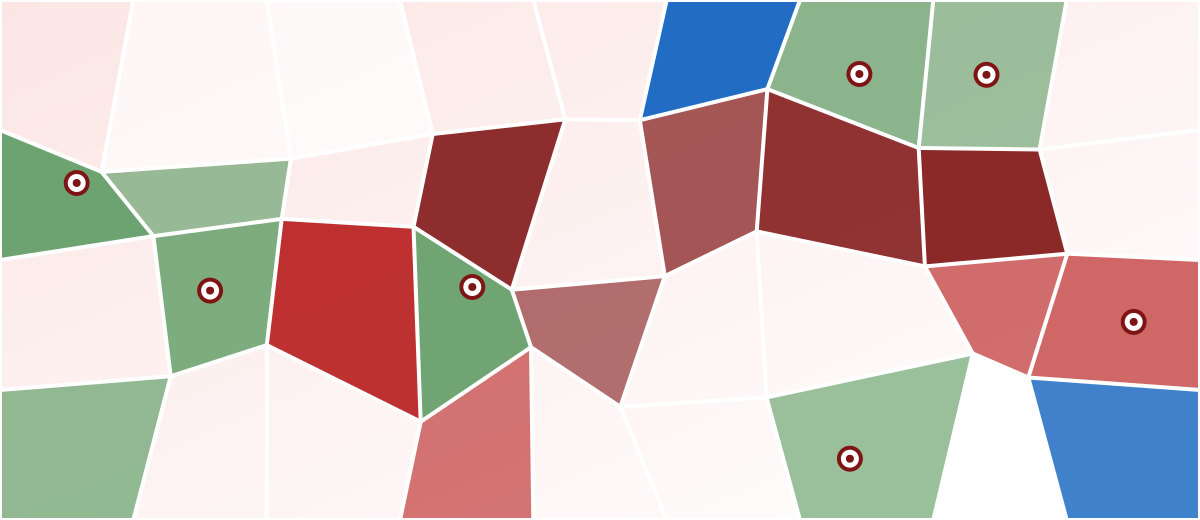
Put Russia and Vatican City side by side in the United Nations yearbook and the first is nearly 39 million times the size of the second. The gap is easy to state. The harder part is the middle of the list, where the order depends on what you decide to count.
Canada and the United States, for example, trade places depending on whether you rank by total area or by land alone. Territories such as Greenland raise a different question. This guide gives the ranking, the numbers behind it and the choices that make rankings differ, so you can quote an area figure with its source.
The ten largest countries by total area
The most consistent source is Table 3 of the UN Demographic Yearbook 2023. It reports surface area in square kilometers and defines it as the total surface area, comprising land area and inland waters, excluding polar regions as well as uninhabited islands. The table below ranks the ten largest countries by that measure.
| Rank | Country | Area (km²) | Area (sq mi, nearest 100) |
|---|---|---|---|
| 1 | Russia | 17,098,246 | 6,601,700 |
| 2 | Canada | 9,984,670 | 3,855,100 |
| 3 | United States | 9,833,517 | 3,796,700 |
| 4 | China | 9,600,000 | 3,706,600 |
| 5 | Brazil | 8,510,417 | 3,285,900 |
| 6 | Australia | 7,692,024 | 2,969,900 |
| 7 | India | 3,287,263 | 1,269,200 |
| 8 | Argentina | 2,796,427 | 1,079,700 |
| 9 | Kazakhstan | 2,724,910 | 1,052,100 |
| 10 | Algeria | 2,381,741 | 919,600 |
Russia leads by a wide margin. Places two to four are close enough to change with the method, because Canada, the United States and China sit within about 385,000 km² of each other. The drop after Australia is large: India has less than half of Australia's area. For why large countries look different on flat maps, see map projections explained.
What is being counted: total area or land area
Total area adds water to land, and countries do not add the same water. Statistics Canada reports Canada's total as 9,984,670 km², made of 9,093,507 km² of land and 891,163 km² of freshwater. The U.S. Census Bureau reports 9,833,517 km² for the 50 states and the District of Columbia, made of 9,147,593 km² of land and 685,924 km² of water. The water is inland, coastal, Great Lakes and territorial water together.
| Measure | Canada (km²) | United States (km²) | Larger |
|---|---|---|---|
| Total area | 9,984,670 | 9,833,517 | Canada, by 151,153 |
| Land area | 9,093,507 | 9,147,593 | United States, by 54,086 |
| Water counted | 891,163 freshwater | 685,924 inland, coastal, Great Lakes and territorial | Different definitions |
The UN notes that its figure for China does not include Hong Kong and Macao, which it lists in their own rows with 1,115 km² and 33 km². Where the status of an area is disputed, sources disagree, and we say so.
Territories change the picture
Rankings of countries leave out many large places. The UN table lists Greenland in its own row with 2,166,086 km². Denmark's row, at 42,947 km², carries a note that it excludes the Faroe Islands and Greenland, which are shown separately. Greenland is a dependent territory, not one of the 195 countries, as explained in dependent territories explained.
If you combined Denmark and Greenland, you would get 2,209,033 km², a little more than Saudi Arabia's 2,206,714 km² and a little less than the Democratic Republic of the Congo's 2,345,410 km². Greenland alone, at 2,166,086 km², is larger than Mexico, with 1,964,375 km². The same pattern shows up with French Guiana, which the UN lists at 83,534 km², apart from France at 551,500 km². A ranking that says "countries" has to say which of these pieces it includes.
The smallest countries
Small states are easier to rank, because the gaps are large. The UN table gives the Holy See, which means Vatican City, a surface area of 0.44 km² in a footnote. Monaco is listed at 2 km², which the UN rounds to a whole number. Monaco is the smallest UN member state, since the Holy See is an observer state, and both are among the 195 countries we count.
| Rank from smallest | Country | Area (km²) | Type |
|---|---|---|---|
| 1 | Vatican City (Holy See) | 0.44 | Enclave in Italy |
| 2 | Monaco | 2 | Coastal city-state |
| 3 | Nauru | 21 | Island country |
| 4 | Tuvalu | 26 | Island country |
| 5 | San Marino | 61 | Enclave in Italy |
| 6 | Liechtenstein | 160 | Double-landlocked |
| 7 | Marshall Islands | 181 | Island country |
| 8 | Saint Kitts and Nevis | 261 | Island country |
| 9 | Maldives | 300 | Island country |
| 10 | Malta | 315 | Island country |
The pattern is clear: six of the ten are island countries, two are enclaves and one is double-landlocked. You can read more in enclaves and exclaves and island nations and archipelagic states.
- Name the source and the year, such as the UN Demographic Yearbook 2023.
- Say whether the measure is total area or land area.
- State whether territories, such as Greenland, are in or out.
- Check how inland, coastal and territorial water is treated.
- Note any rounding, since the UN rounds some figures, and any area whose status is disputed.
Common mistakes with area rankings
- Mixing total area and land area
Canada leads the United States by total area, and the United States leads Canada by land area. Always say which measure you use.
- Treating the third and fourth places as settled
The United States and China are only 233,517 km² apart in the UN table, and the gap depends on how territorial water is counted. Say "about" and name the source.
- Judging size from a flat map
Every flat map distorts area, so a country can look much bigger or smaller than its figure. Use the numbers, not the picture.
- Ranking territories as countries by accident
Greenland has 2,166,086 km² and is larger than Mexico, but it is not one of the 195 countries. Decide in advance whether a ranking includes territories.
- Quoting a figure without a source
Area figures differ by year, method and rounding. The UN rounds Monaco to 2 km² and China to 9,600,000 km². A sourced figure can be checked, and an unsourced one cannot.
Frequently asked questions
Which country is the largest by area?
Russia, at 17,098,246 km² in the UN Demographic Yearbook 2023. Canada follows at 9,984,670 km². The order of the next places can change depending on whether you rank by total area or by land area.
Which country is the smallest by area?
Vatican City is the smallest, at 0.44 km² in the UN's footnote. It is an observer state, so the smallest UN member state is Monaco, at 2 km² in the same table.
Is Canada or the United States bigger?
Canada is bigger by total area: 9,984,670 km² against 9,833,517 km². The United States is bigger by land area alone: 9,147,593 km² against 9,093,507 km². Each country adds water to its total in its own way.
Is Greenland a country?
No. The UN lists Greenland in its own row, apart from Denmark, and it is a dependent territory. At 2,166,086 km² it is larger than Mexico, but it is not one of the 195 countries in our count.
Why do different sites rank countries differently?
They measure different things. Some use total area, others use land area. Some add territorial water, and some count or leave out territories and disputed areas. The source, the year and rounding also vary. Check the definition before you compare two lists.
Sources
- Demographic Yearbook 2023, Table 3: Population, annual rate of change, surface area and density United Nations Statistics Division
- Demographic Yearbook 2023, Notes to Table 3 United Nations Statistics Division
- Table 15.6 Land and freshwater area, Canada and selected countries Statistics Canada (source: Natural Resources Canada, Atlas of Canada)
- State Area Measurements and Internal Point Coordinates (2010) U.S. Census Bureau
- Member States United Nations
- Non-Member States United Nations